
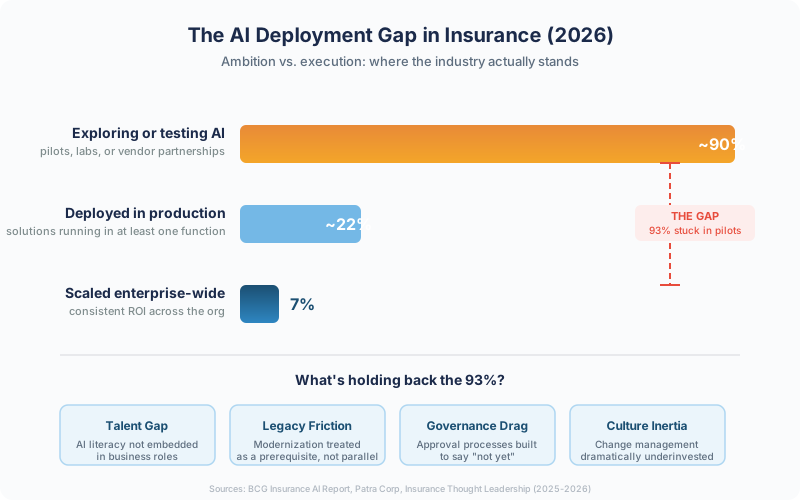
The insurance industry has no shortage of AI ambition. Virtually every major carrier has launched a pilot, funded an innovation lab, or announced a partnership with a technology vendor. And yet, according to industry research, only about 7% of insurers have achieved scalable AI success, moving from experimentation into production at scale.
That gap, between intent and impact, is the defining strategic challenge for insurance leaders right now. Not whether AI matters (it does), but why so few organizations can actually operationalize it.
The carriers who have figured this out, Travelers, Allianz, Progressive, and a handful of others, aren’t succeeding because they found better algorithms. They’re succeeding because they solved the organizational problems that most insurers haven’t confronted yet.
Here’s what separates the 7% from the 93%.
1. They Closed the Talent Gap Before Buying the Technology
Most insurers approach AI as a technology procurement challenge. They invest in platforms and tools, then scramble to find people who can use them. The carriers scaling successfully did the opposite: they built or acquired the talent first, then let capability drive adoption.
This doesn’t mean hiring an army of data scientists. It means embedding AI literacy into the roles that matter most. Underwriters who understand how a model scores risk, claims managers who can interpret automated triage decisions, and product leaders who can identify where machine learning creates genuine competitive advantage.
The 93% tend to centralize AI expertise in an innovation team that operates at arm’s length from the business. The 7% distribute it.
2. They Treated Legacy Systems as a Sequencing Problem, Not a Blocker
Legacy infrastructure is the most cited barrier to AI adoption in insurance. It’s also the most overused excuse.
Yes, decades-old policy administration systems and siloed data environments create real friction. But the carriers scaling AI didn’t wait for a multi-year core system transformation to finish before deploying models. They identified high-value use cases that could operate within, or alongside, existing systems, then expanded from there.
Travelers, for example, has deployed AI across claims, underwriting, and customer service without a wholesale rip-and-replace of its technology stack. The approach is pragmatic: wrap modern capabilities around legacy systems where possible, and prioritize the data pipelines that feed the highest-impact models.
The mistake most insurers make is treating legacy modernization and AI deployment as sequential projects. The carriers that scale treat them as parallel work streams with shared priorities.
3. They Built Governance That Enables Speed, Not Just Compliance
AI governance in insurance is genuinely complex. Regulatory scrutiny around algorithmic bias, model explainability, and fair lending practices is intensifying. Most insurers respond by creating governance frameworks that are thorough but slow, with multi-layered approval processes that turn a 90-day deployment into a 12-month odyssey.
The 7% built governance structures that are equally rigorous but far more efficient. They established clear model risk tiers, so a chatbot enhancement doesn’t require the same review as a pricing algorithm. They created standing committees with decision-making authority rather than advisory boards that generate recommendations. And they invested in tooling (model monitoring, bias detection, audit trails) that makes compliance continuous rather than episodic.
The goal isn’t less governance. It’s governance designed to say “yes, with guardrails” instead of “not yet.”
4. They Changed the Culture, Not Just the Technology
This is the barrier nobody wants to talk about, and it’s the one that matters most.
Scaling AI requires people to work differently. Underwriters need to trust model outputs alongside their own judgment. Claims teams need to accept that automated decisions can handle routine cases while they focus on complex ones. Leaders need to fund initiatives where the ROI is probabilistic, not guaranteed.
None of that happens without deliberate cultural change. The carriers succeeding at scale have invested as heavily in change management as in technology. They’ve run structured programs to build confidence in AI-assisted decision-making. They’ve adjusted incentive structures so that adopting new tools is rewarded, not treated as an implicit threat. And critically, they’ve been transparent about what AI will and won’t change about people’s roles.
The 93% tend to underinvest here dramatically. They treat AI as a technology initiative with a training component, rather than a business transformation with a technology component.
The Path Forward
If your organization is part of the 93%, the prescription isn’t to move faster. It’s to move differently. Start with an honest assessment of the four barriers above. Where is your real bottleneck? For most insurers, it’s not technology. It’s some combination of talent distribution, governance friction, and cultural resistance.
Then pick one or two high-impact use cases where you can demonstrate value within six months, not two years. Claims triage, submission intake, and customer service automation remain the most accessible entry points with measurable ROI.
And stop treating AI as a side project. The carriers in the 7% have made AI deployment a standing agenda item at the executive level, with clear ownership, dedicated funding, and accountability for results. The gap between AI ambition and AI execution in insurance is real. But it’s closable, if you’re willing to confront the organizational challenges that technology alone can’t solve.
If your team is navigating any of these barriers, FiveM can help. We work with insurance carriers and MGAs to move AI from pilot to production, tackling the talent, governance, and change management challenges that technology vendors won’t. Get in touch to discuss where you’re stuck and what it would take to break through.