

Most insurers do not fail at digital transformation because of bad technology. They fail because of fragmented visibility.
Walk into any large carrier today and you will find five, eight, sometimes twelve concurrent digital programs running in parallel, each with its own project manager steering committee, and definition of success. No one is looking at all of them at once. That gap is quietly destroying transformation value at scale.
Why the Dashboard Illusion Is Not Enough
Every carrier has some form of reporting. RAG status decks, quarterly steering updates, program-level PMO trackers. These create the appearance of control without the substance of it. When each program reports independently, you get a collection of local truths, not a coherent picture of how those programs interact or whether the portfolio is aligned with the business case that justified the investment. By the time a problem surfaces in a monthly steering committee, it has been compounding for weeks. This is the gap a Control Tower is designed to close.
What a Control Tower Is, and What It Is Not
A Control Tower is not a PMO. It is not a reporting layer. It is not a dashboard with more data. It is a living operational nerve center that integrates cross-program signals into decision-ready intelligence, operating in real time, not in reporting cycles. Think of it as the difference between reporting on a transformation and steering one.
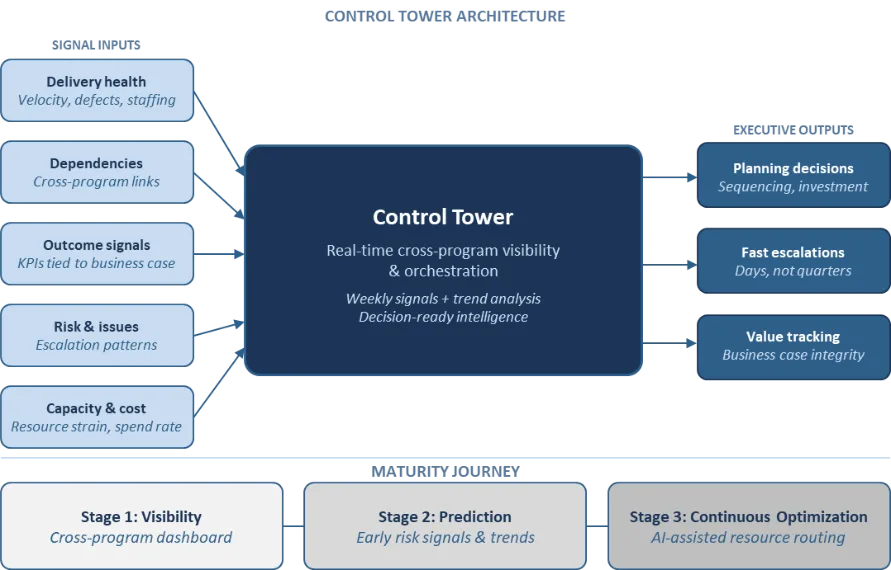
Figure 1: The Control Tower architecture consists of five signal inputs feeding the central orchestration layer, generating three executive outputs across a three-stage maturity journey.
Delivery health signals: Velocity, defect rates, environment stability, and staffing levels across every program as trends, not snapshots.
Dependency mapping: Where one program’s timeline creates pressure on another. A core systems delay that ripples into a distribution launch eighteen months later is a Control Tower problem no individual PMO will catch.
Outcome signal tracking: Delivery milestones connected to business outcomes. The Control Tower keeps the business case visible as the program evolves.
Risk and escalation intelligence: Where issues are accumulating and which decision gaps have gone unresolved, made visible before they become expensive.
Capacity and cost signals: Resource strain and spend rate across the portfolio, flagging where investment is drifting from its approved trajectory.
Why Insurance Is Different
Generic transformation governance frameworks exist. Most do not survive contact with the insurance operating environment. Four factors make cross-program visibility both uniquely difficult and uniquely necessary.
Regulatory change does not pause for transformation. IFRS 17 implementation, state-level regulatory updates, and model governance requirements run parallel to core modernization programs, not sequentially. A Control Tower holds regulatory milestones alongside technology milestones and flags conflicts between them before they become compliance events.
The vendor ecosystem is fragmented. A typical transformation involves a core system vendor, a systems integrator, a cloud provider, and multiple data platform vendors, each with its own release cadence and definition of “done.” When something breaks across that ecosystem, no single vendor owns the problem. The Control Tower is the only structure positioned above all of those relationships that can see the interaction effects and force accountability.
Actuarial and IT cycles run on different rhythms. Actuarial models change quarterly; core system releases move on a different cadence entirely. Without visibility across both, misalignment accumulates silently until a rate filing deadline forces it into the open. Carriers managing runoff books carry additional burdens of legacy claims, regulatory reporting, and reinsurance data feeds that cannot be switched off while modernization happens around them.
Distribution complexity multiplies dependencies. Digital distribution builds, broker portal modernizations, and embedded insurance initiatives each carry their own timelines and vendors. Running those alongside a core system replacement and a data platform build creates interaction effects that are routinely underestimated and invisible to any single PMO. A Control Tower built for insurance can hold all of it.
The Three Things a Control Tower Changes

Figure 2: The three executive outcomes a Control Tower capability delivers.
Planning fidelity. Without cross-program visibility, prioritization decisions are made on politics rather than data. A Control Tower changes those inputs by sequencing based on actual dependency data, not the loudest sponsor in the room.
Decision speed. The most expensive thing in a large transformation program is a decision that should have taken two days and took two months. By surfacing issues with the right context and routing them to the right decision-maker, a Control Tower compresses the decision cycle from quarters to days. That compression is where transformation ROI is recovered.
Value realization. Most programs declare success at go-live. A Control Tower keeps the business case visible throughout the lifecycle, tracking whether outcomes are trending in the right direction and flagging drift early enough to course correct. That is the difference between a program that delivers and a program that was delivered.
The Maturity Journey
A Control Tower is not a capability you install. It is a capability you build, and it matures in stages. Carriers do not need to solve for all three at once. Understanding what each stage actually delivers is what makes the journey feel credible rather than aspirational.
Stage one: Visibility. A real-time, cross-program dashboard giving leadership a single view of program status, dependency flags, and resource utilization. The technology required is modest. The organizational change of getting program teams to report into a shared intelligence layer rather than defending their individual status is harder. But this stage alone eliminates the most common failure mode: problems that compound for months before anyone with authority sees them.
Stage two: Prediction. Trend analysis that identifies programs drifting before they miss milestones. Dependency conflict alerts that surface potential collisions weeks before they materialize. Risk signals that give leaders time to act rather than react. At this stage, the Control Tower stops being a reporting tool and starts behaving like an early warning system.
Stage three: AI-assisted resource routing. This is where the capability becomes a genuine strategic decision support tool. The hardest resource decisions in insurance transformation are not made in planning meetings. They are made under pressure, with incomplete information, when a regulatory deadline moves or a vendor misses a sprint and someone has to decide which program gets the architect and which one waits. Most carriers make that call on instinct. A mature Control Tower makes it on data, modeling the downstream effect of each option before the decision is made, so the trade-off is visible before it is irreversible. You do not need this to get started. But if you start now, you will be ready for it when the organizational maturity catches up.
Building the Capability
A Control Tower without authority is just another dashboard. For it to function as a steering mechanism, it needs three things: access to real program data (not sanitized status reports), the authority to escalate when signals are unfavorable, and a direct line to the executives who make sequencing, resource, and investment decisions. Define who owns it, what decisions it can trigger, and the escalation path from signal to resolution. Without that clarity, even the best visibility tool gets ignored when it delivers inconvenient news.
The Bottom Line
The era of running ten transformation programs and hoping they stay aligned is over. The programs are too complex, too interdependent, and too consequential for hope to be a governance strategy.
Carriers who build a Control Tower capability will plan with better information, decide faster, and realize more of the value they set out to create. Carriers who do not will keep discovering that problems addressable in Q1 are now costing them Q3.
The Control Tower is not a luxury. It is the operating model that makes transformation governable. And for most insurers, building it is long overdue.